What a Brain is
A Brain is pages of fact cards — one card per claim: title, substance, and the number behind it. Eight shelves (Openers, Credibility, Stories, Offer, Process, Audiences, Voice, Closers) cut across the pages by deck role; when Slyde writes a deck, it shops the shelves. It never invents facts: if the Brain doesn’t know it, the deck won’t claim it.
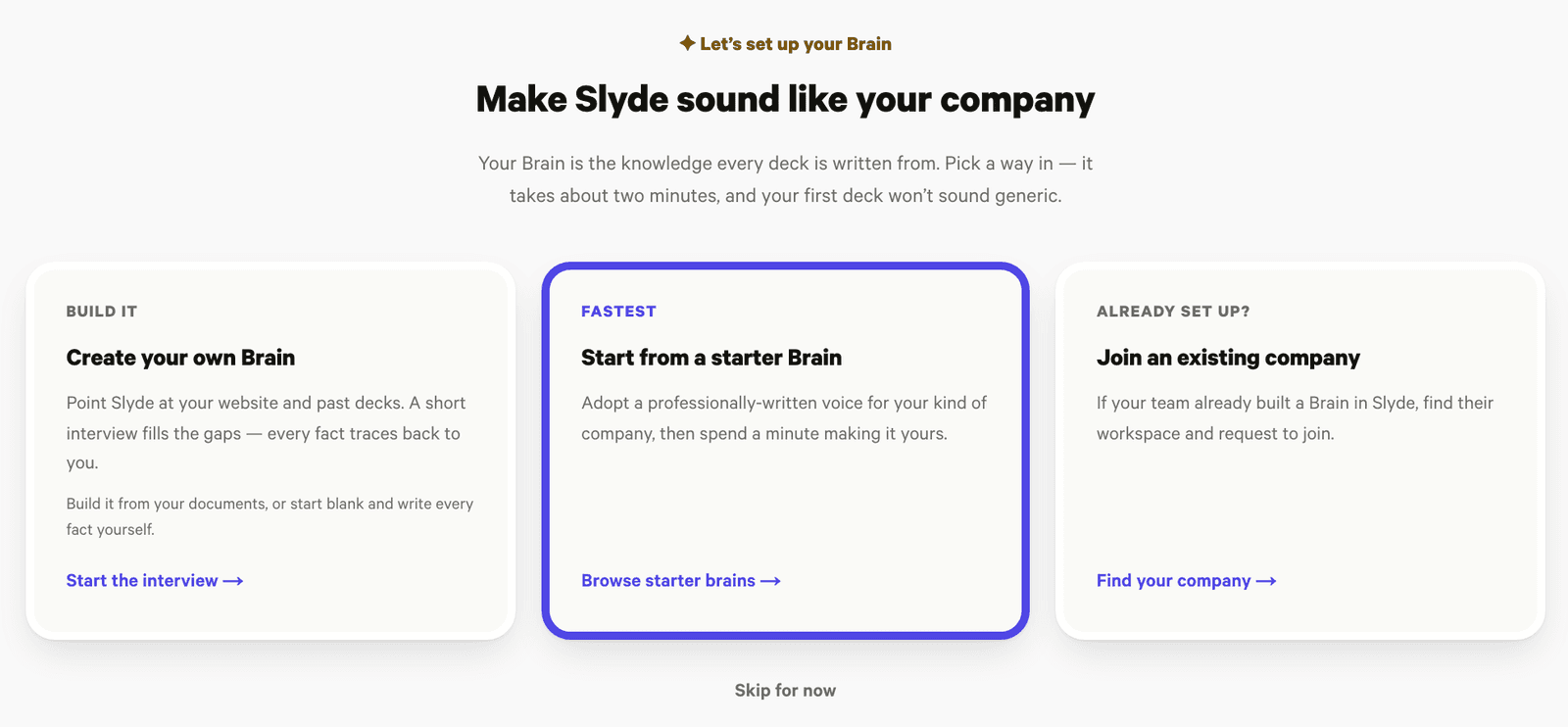
Three ways in
- Build from your documents. Drop in past decks and brand PDFs. The rest of this tutorial follows this road.
- Start from a starter Brain. Pre-shaped for your kind of company; replace its content with yours.
- Start with a blank Brain. The link at the bottom of the build form. Write cards by hand; run the AI build any time later.
The build form
- Enter your Company name — the only required field.
- Add your Website URL — Slyde reads it for positioning and tone.
- Drop files into Brand materials & past decks — PDF, Markdown or plain text. Past decks are the highest-value input; scanned, image-only PDFs are skipped.
- Tick Import case-study photos from PDFs to save each project’s pages into your image library.
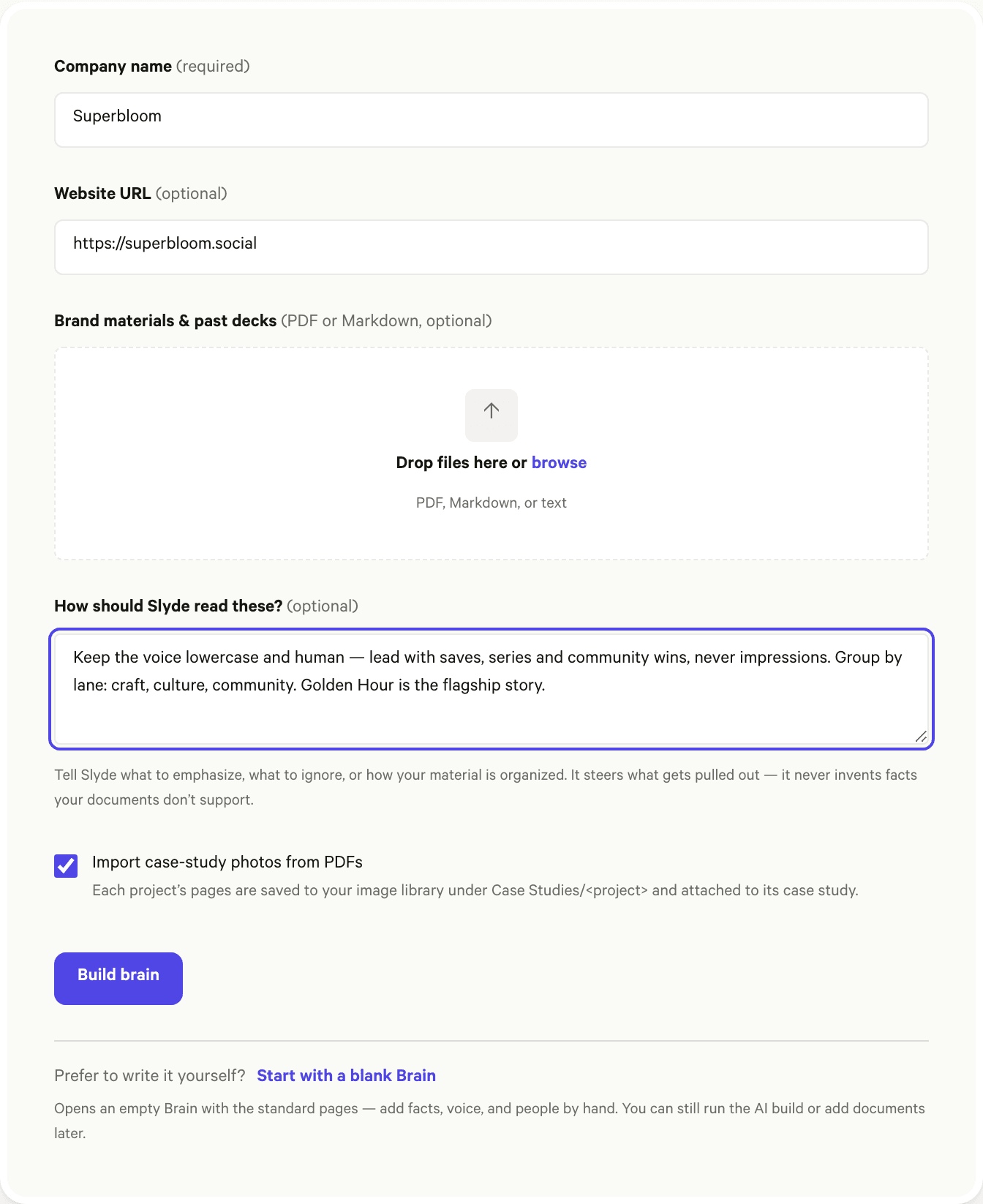
“How should Slyde read these?”
The highest-leverage field on the form — one paragraph here decides the calls Slyde would otherwise guess when your documents disagree. Cover five things, a sentence each:
- Rank the sources: name what wins conflicts.
- Say what the Brain is for — the decks it will write.
- Say how to group — the pages you think in.
- Name the voice your cards should carry.
- Name what to skip.
A worked example
“These are our last three pitch decks plus our brand book — the 2025 capabilities deck is the source of truth and wins conflicts. This Brain is for pitching experiential work to museum and cultural clients, so pull hard on project stories and results. Group by service line: strategy, spatial design, media production. Voice: confident and plain, never breathless. Skip the pricing appendix in the 2023 deck.”
The build, and what you get
- Press Build brain. Slyde reads each source, proposes the pages, then writes the cards — progress on screen. Cancelling costs nothing.
- Read the result like an editor. Cards should carry real numbers — “214% average ROI across 40 retail activations,” not “strong results.”
- Fix the card, not the deck: correct it once and every deck after uses the fix.
Improving cards
- Edit any card in place — title, body, metric, shelves.
- Click Deepen on a thin card: it rewrites richer, grounded in the Brain’s own sources.
- Keep a source-of-truth Markdown file? Drop it in the build form for Verbatim import — flagged “imports as-is,” your words land unrewritten.
Case studies and people
Case studies are full project records — client, challenge, approach, result, photos — extracted during the build or imported from a PDF later; story slides draw on them whole. People are team bios with photos. Fill both in and story and team slides stop being rebuilds.